Red Sea Diving
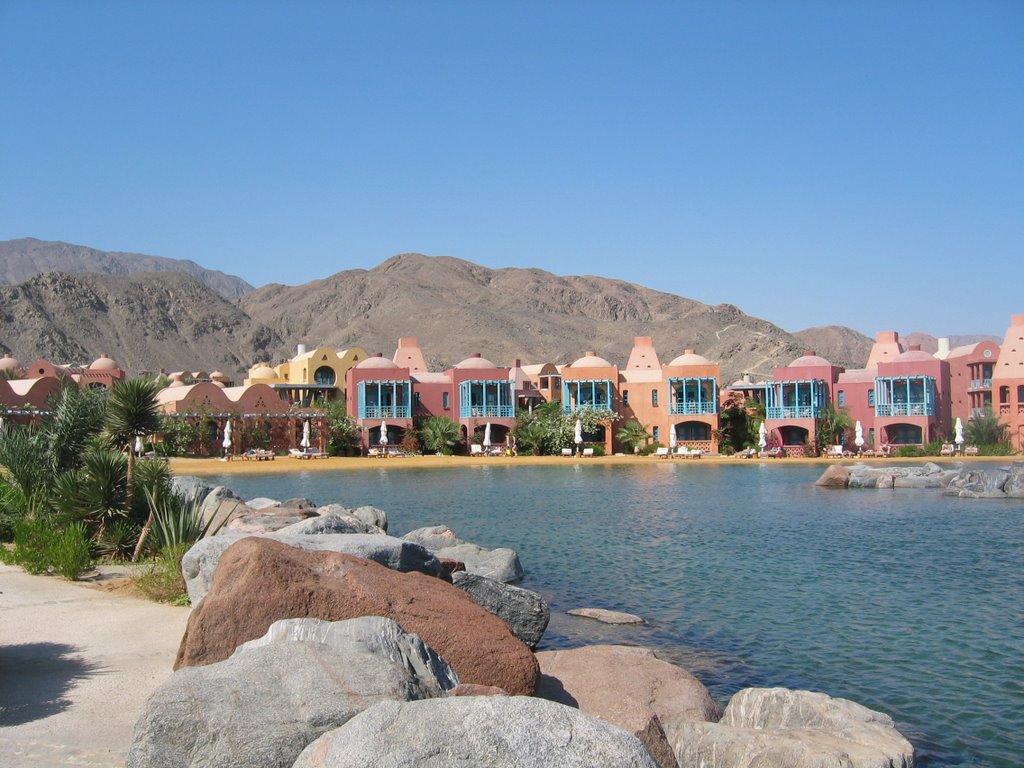 Taba Heights Hyatt hotel is like a mini village
I haven't posted in a while as I've recently returned from holidaying in Egypt, learning to dive in the Red sea. As a newly qualified PADI open water diver, I now feel the urge to don some scuba gear and get closer to my koi, but I'm not sure if they would appreciate it. On second thoughts perhaps not, as although I wore a wet suit and the water temperature rarely gets much cooler in the Red sea, it was still a very comfortable 24C.
I stayed in a little resort called Taba Heights that has literally sprung up over night on the edge of the Gulf of Aqaba, on a barren piece of land that backs onto the Sinai mountains. The area is a beautiful man made oasis of a handful of five star hotels and a golf course, which makes it perfect for relaxing but the real attraction is to be found on the reefs just off the beach. The variety and abundance of life in the sea is truly breath taking and something everyone should experience at least once. It's an exhilarating experience although at first it felt odd not having a sheet of glass between me and the fish. The instructors from the dive school, which is sponsored by the National Geographic, explained that we should be careful not to damage the environment as it is a protected area, but the greatest threat is not from divers but from pollution from nearby ports and fish farms.
Taba Heights is very close to the Israeli border and the city of Eilat which has many fish farms in the area, mostly for food fish but inland they do grow ornamental fish. I wasn't able to visit so I don't know if they farmed koi there or not but I have heard that scientists have been working there on a vaccine for KHV, and helped develop the process that MagNoy currently use to inoculate against the disease. Whether or not you agree with their approach, personally I think it's early days yet before anyone can claim KHV free koi for life, but their top quality koi are now very good. With their winter temperatures more like our summer in the UK, it's easy to see how the koi grow so quickly. Coming back to rainy Britain is quite a shock and makes you realise how short our growing season is without heating.
I stayed in a little resort called Taba Heights that has literally sprung up over night on the edge of the Gulf of Aqaba, on a barren piece of land that backs onto the Sinai mountains. The area is a beautiful man made oasis of a handful of five star hotels and a golf course, which makes it perfect for relaxing but the real attraction is to be found on the reefs just off the beach. The variety and abundance of life in the sea is truly breath taking and something everyone should experience at least once. It's an exhilarating experience although at first it felt odd not having a sheet of glass between me and the fish. The instructors from the dive school, which is sponsored by the National Geographic, explained that we should be careful not to damage the environment as it is a protected area, but the greatest threat is not from divers but from pollution from nearby ports and fish farms.
Taba Heights is very close to the Israeli border and the city of Eilat which has many fish farms in the area, mostly for food fish but inland they do grow ornamental fish. I wasn't able to visit so I don't know if they farmed koi there or not but I have heard that scientists have been working there on a vaccine for KHV, and helped develop the process that MagNoy currently use to inoculate against the disease. Whether or not you agree with their approach, personally I think it's early days yet before anyone can claim KHV free koi for life, but their top quality koi are now very good. With their winter temperatures more like our summer in the UK, it's easy to see how the koi grow so quickly. Coming back to rainy Britain is quite a shock and makes you realise how short our growing season is without heating.
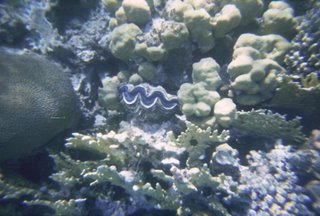 Snorkelling off the beach I spied this Giant Clam
This holiday has made me more conscious of environmental issues, especially the threats to coral reefs some of the most delicate and important ecosystems on the planet. Some of this complexity can be thought about when compared to our koi ponds, with which we only have to provide the right conditions for one species, whereas in the seas many thousands of species rely on favourable conditions that nobody has control over.
Labels: environment, fishkeeping, KHV, koi, scuba
posted by Alex-san @ 12:15 PM
5 comments