Monday, November 27, 2006

Red Sea Diving

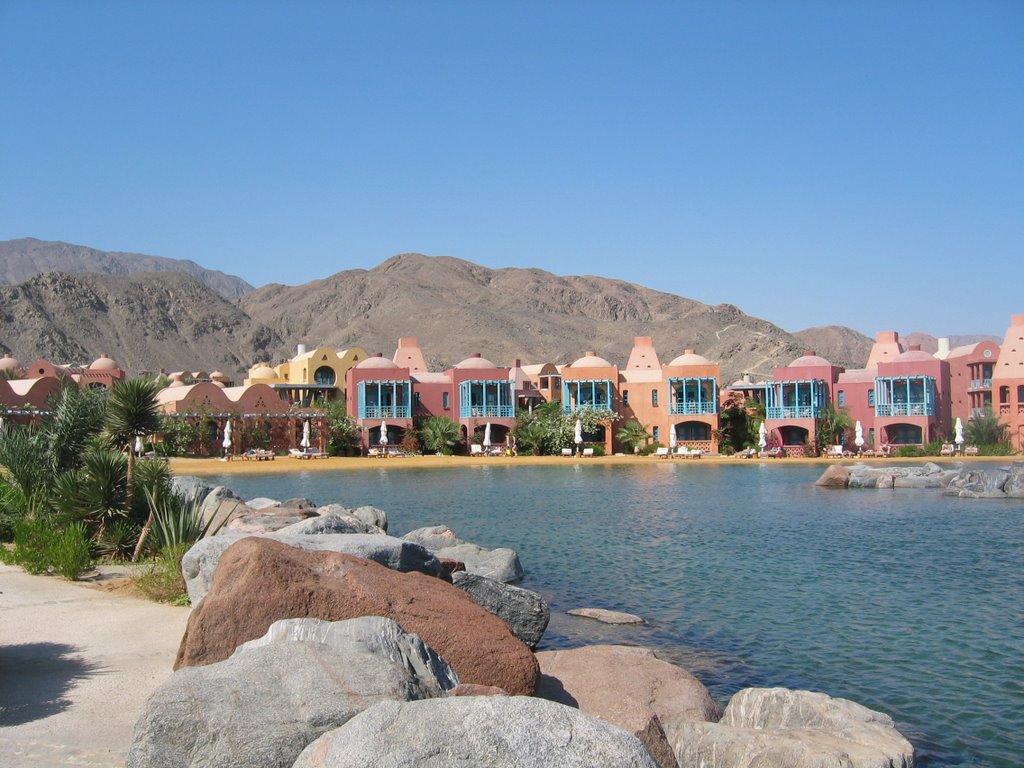
Taba Heights Hyatt hotel is like a mini village

I haven't posted in a while as I've recently returned from holidaying in Egypt, learning to dive in the Red sea. As a newly qualified PADI open water diver, I now feel the urge to don some scuba gear and get closer to my koi, but I'm not sure if they would appreciate it. On second thoughts perhaps not, as although I wore a wet suit and the water temperature rarely gets much cooler in the Red sea, it was still a very comfortable 24C.

I stayed in a little resort called Taba Heights that has literally sprung up over night on the edge of the Gulf of Aqaba, on a barren piece of land that backs onto the Sinai mountains. The area is a beautiful man made oasis of a handful of five star hotels and a golf course, which makes it perfect for relaxing but the real attraction is to be found on the reefs just off the beach. The variety and abundance of life in the sea is truly breath taking and something everyone should experience at least once. It's an exhilarating experience although at first it felt odd not having a sheet of glass between me and the fish. The instructors from the dive school, which is sponsored by the National Geographic, explained that we should be careful not to damage the environment as it is a protected area, but the greatest threat is not from divers but from pollution from nearby ports and fish farms.

Taba Heights is very close to the Israeli border and the city of Eilat which has many fish farms in the area, mostly for food fish but inland they do grow ornamental fish. I wasn't able to visit so I don't know if they farmed koi there or not but I have heard that scientists have been working there on a vaccine for KHV, and helped develop the process that MagNoy currently use to inoculate against the disease. Whether or not you agree with their approach, personally I think it's early days yet before anyone can claim KHV free koi for life, but their top quality koi are now very good. With their winter temperatures more like our summer in the UK, it's easy to see how the koi grow so quickly. Coming back to rainy Britain is quite a shock and makes you realise how short our growing season is without heating.
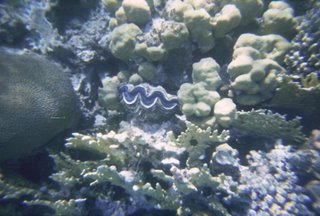
Snorkelling off the beach I spied this Giant Clam

This holiday has made me more conscious of environmental issues, especially the threats to coral reefs some of the most delicate and important ecosystems on the planet. Some of this complexity can be thought about when compared to our koi ponds, with which we only have to provide the right conditions for one species, whereas in the seas many thousands of species rely on favourable conditions that nobody has control over.

Labels: , , , ,

Monday, October 30, 2006

Water Experiment

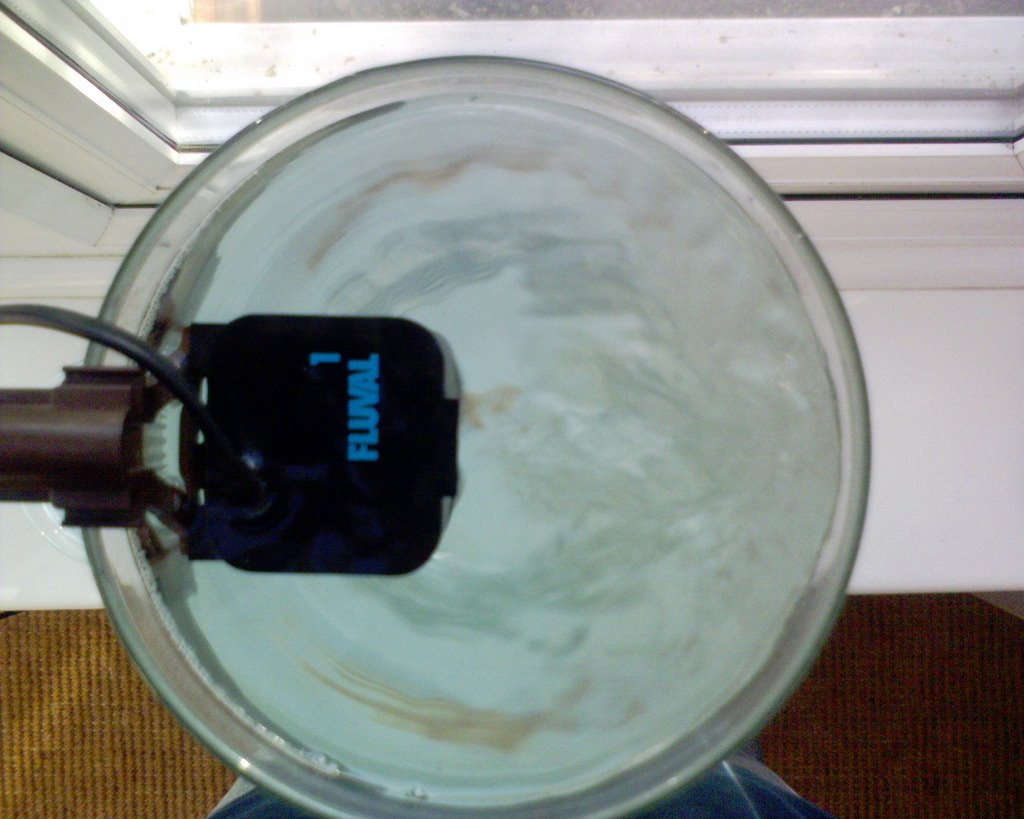
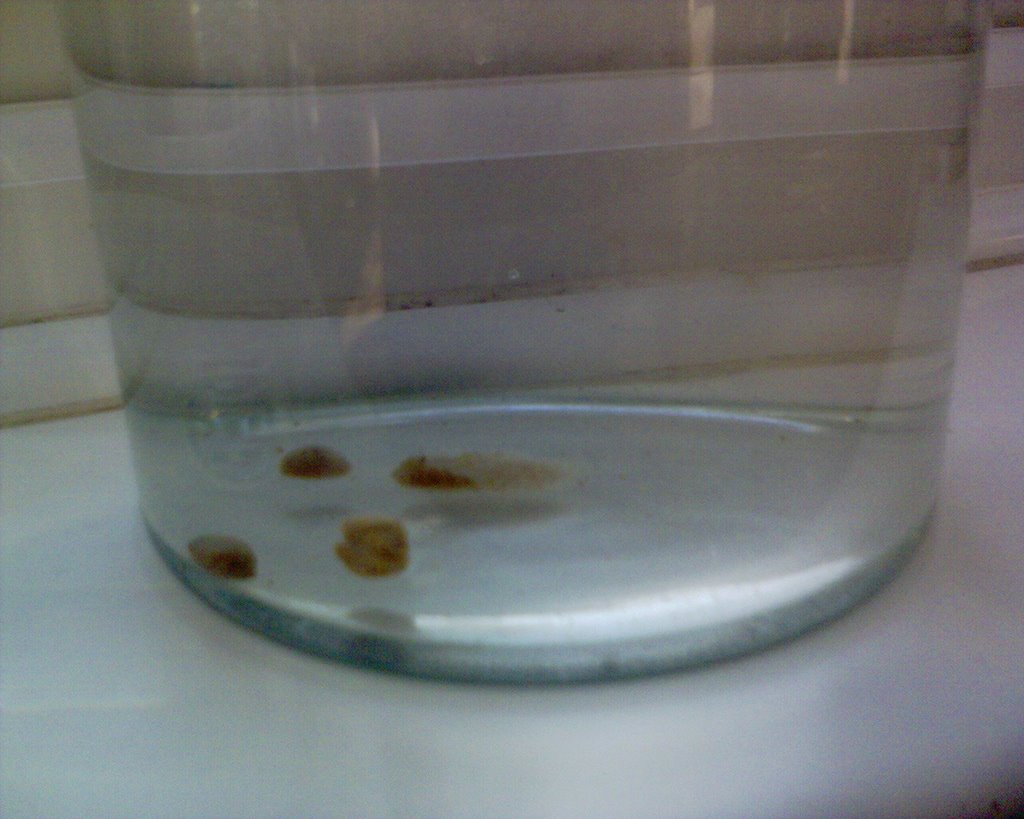
My experiment is now into its third week and slightly disappointingly there's still no sign of any algae. Last weeks weather was very dull and grey though, not ideal for growing algae. So far all I've added is a total of 4 koi pellets. They take on average 2 days to sink and so far only the first one has finally broken up. Earlier in the week the water did become a little milky in colour, which could have been a bacterial bloom but things now look much as they did at the start. This weekend I did a few tests to see if anything was going on.

pH
The first pH reading was 7.5 and quite surprisingly it's now 8.4! I was expecting if anything a move the other way towards acid. Thinking my first test was wrong I have re-tested the tapwater and water left to stand, and got the same results as before. To some fish keepers this may seem obvious but something in tapwater probably CO2 or chlorine, effects the pH. I have heard that carbon water purifiers can lower the pH in much the same way. This means that the pH hasn't changed because of anything in the experiment, but due to it being left to stand.

Ammonia & Nitrite
I have successfully created water that would be deadly to most life, let alone koi. This is a boast I don't want to make too often, but it's good to see a result. Ammonia levels are close to 1 mg/l which at a pH of 8.4 would quickly prove fatal. Equally deadly the nitrite readings are off the scale at over 2 mg/l. The fact they are both present confirms that the koi pellets are being broken down and some nitrification is going on, but it may take a few more weeks to achieve an equilibrium. Although the total ammonia concentrations are much higher in industrial waste water treatments, higher levels can even inhibit the bacteria that feed on it. With nitrite approximately double the ammonia, the next step is establishing enough nitrite oxidising bacteria. I would hazard a guess that the ammonia levels, if not coming down are being controlled.

Nitrate
Nitrate is up to 50 mg/l double what the start level was. I'm not totally sure how this has happened, but I suppose some oxidation of nitrite must have occurred. This is not an unreasonable level to have in a koi pond, and with limited ways for nitrate to escape most people rely on water changes to keep it down. With nitrates in my tapwater measuring 25 mg/l, it's fairly obvious that quite large amounts are needed to control the rise.

Nitrate is often blamed for causing algae but like other plants it is just one of several requirements needed. Algae has even been known to survive in distilled water when all the other components are strong. The levels in my tapwater are more than enough so I will give it a bit more time before looking for clues.

Conclusions so far
I've been really surprised how quickly it has taken for the water to become toxic. Admittedly it's only 10 litres and there's a very small surface area, but this is bigger than some goldfish bowls and the filter pump turns the water over quickly. This just goes to show how polluting koi food is and how even if the water looks clear it may not be suitable for koi to live in. One reason for the rapid bacterial activity could be due to the probiotics in Saki-Hikari, but I have no way of telling. Visually there is no discernible difference between the two brands of koi food that I have used. This is something I may test in another experiment.

Having only added 4 pellets of food I was worried that without any koi present, part of the cycle was missing and ammonia would be in short supply. There is a technique that some koi and tropical fish keepers use when starting up a new pond or aquarium called a 'fishless cycle'. This is useful because the fish are spared the extremes of ammonia and nitrite as the filter establishes itself. Without the fish an ammonia source has to be added, in my case with the koi pellets, but for those whom don't wish to waste expensive koi food a cheaper and more controllable option is to add ammonium chloride or ammonium hydroxide. These are often found in household cleaners but don't use any with scents or surfactants, only 100% ammonia.

With plenty of nutrients in the water I think I can cut feeding, and possibly change a small amount of water, if ammonia levels don't come down. There are modifications I can make to the set up and I have plans to do other tests, but for now I will keep things simple and see what happens.

Labels: , ,

Friday, October 27, 2006

Piscinarii

Piscinarii.com has kindly given this blog Koi Carp a mention, so I thought I would share a little link love and return the favour. This is not difficult though as Piscinarii.com is one of the most entertaining and interesting fish keeping blogs out there. Recent posts have covered everything from movies and celebrities, through to how religion can influence keeping fish. This blog comes from the Philippines, a country with many tropical fish enthusiasts and a growing number of koi fans. It has been reported recently that their fish farmers have been considering diversifying into koi breeding due to new demand and the high costs of importation. While it's easy to get envious of their climate, there are a few unique problems that their koi keepers have to deal with, such as Typhons.

Piscinarii for those like me that didn't study Latin at school, is the name for a fish pond owner. Marcus Cicero used it to describe rich Roman citizens who were more interested in keeping their ornamental ponds than in politics. It became associated as a derisive term implying madness. Perhaps a modern alternative for someone with an obsessive interest would now be called an Otaku in Japanese, or more tongue in cheek for a koi fan, Koi Kichi. These terms though only relate to a persons deep interest in the subject, whereas Cicero's use of Piscinarii was to poke fun at the rich and powerful whose ponds were status symbols for showing off.

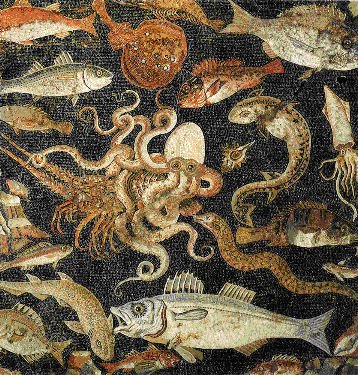
The Romans became quite adept at keeping fish in ponds they called Piscinae, but it was found easier and more profitable to grow freshwater fish for food. Sea fish were preferred though so a divide grew between salt water ponds (Piscinae Salsae), which were expensive and mostly for novelty value and freshwater ponds that were a source of food for the average Roman citizen. It was written in 37 BC that a ponds appeal was to the eye rather than the purse, which it emptied rather than being filled. This is something many koi keepers can identify with.
"For in the first place they are built at great cost, in the second place they are stocked at great cost, and in the third place they are kept up at great cost"

With Roman nobility trying to out do each other in the late republic, they would build grand villas by the sea with fishponds in coves and inlets, much like the swimming pools at millionaires pads today. Many were built from an early concrete that set underwater and used a network of channels with brass grates to regulate the level and salinity.

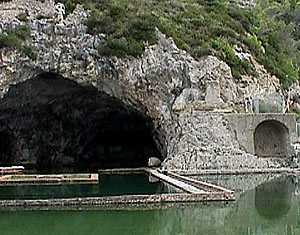
The photo above shows part of a saltwater fishpond that belonged to the Emperor Tiberius. This pond mixes with the sea at high tide, but like many Roman fishponds of the time, it's mainly brackish as it's diluted by natural springs in the cave. There's a narrow channel that connects the sea to the pond and allows fish to enter but not escape. The fish must have thought they were swimming up stream, attracted by the freshwater. It has been suggested that the four tanks in the centre were used to house fish that if put together would eat each other but could just have easily been used to place fish for easy catching. People probably slaves, were employed to catch food for the fish and sometimes they would even buy it from the market.

How long they managed to keep these fish alive I don't know, but it's quite amazing to think that around the time of Jesus, and without all the modern equipment we have today, people were enjoying a similar hobby. Although it's well known that the Chinese have kept ornamental fish for thousands of years, it's most likely that the Romans were the first to spread the use of aquaculture throughout Europe, with it later being continued by medieval monks.

Labels: ,

Bloggeries Blog Directory Find Blogs in the Blog Directory Blog Flux Directory